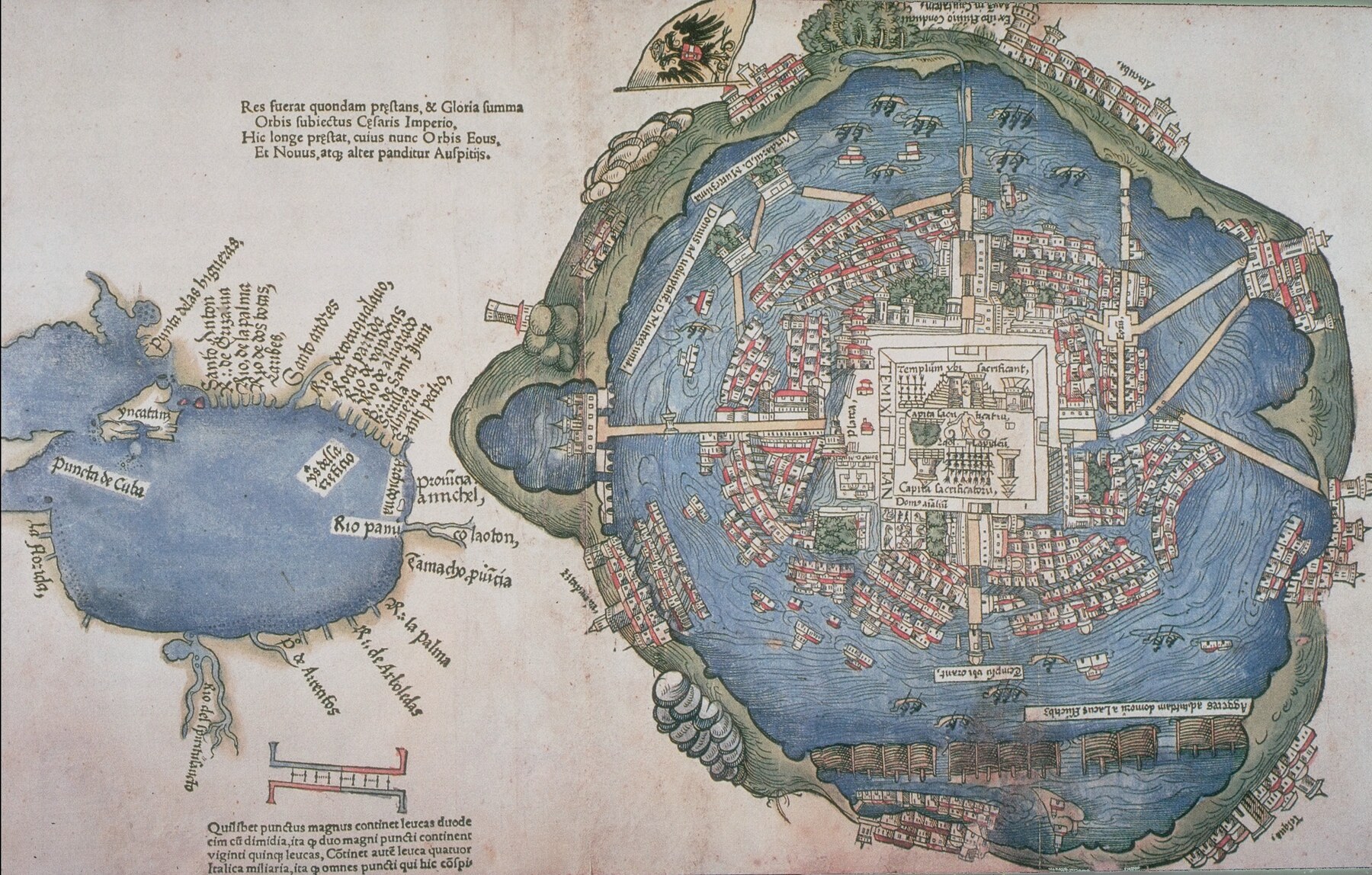
The Mexica Empire Before Cortés
In 1519, the Mexica were the leading power in a large Mesoamerican empire often called the Aztec Empire. Tenochtitlan, their island capital in Lake Texcoco, was joined to the mainland by causeways. It had canals, markets, temples, schools, and carefully managed water and farming systems. The Mexica ruled through the Triple Alliance with Texcoco and Tlacopan.
The empire collected tribute from many conquered cities and provinces. Tribute brought food, cloth, precious materials, and other goods to the capital. Some subject peoples benefited from trade or local power, while others resented Mexica demands. These relationships would strongly affect the invasion that followed.
Cortés Enters a Divided Political World
Hernán Cortés landed on the Gulf Coast in 1519 with several hundred Spaniards. He did not enter an empty land or face one united people. Mesoamerica contained many independent and competing states. Cortés used interpreters, including Malintzin, a Nahua woman who translated, advised, and helped negotiate with local leaders.
After fighting the Tlaxcalans, Cortés formed an alliance with them. Tlaxcala had long resisted Mexica power. Thousands of Tlaxcalan warriors and other Indigenous allies later joined the campaign. Their knowledge, supplies, military strength, and political goals were essential; the Spaniards could not have reached or defeated Tenochtitlan alone.
Meeting, Captivity, and Revolt
Moctezuma II, the Mexica ruler, received Cortés in Tenochtitlan in November 1519. Sources disagree about what each leader expected from the meeting. Spanish accounts sometimes claimed that Moctezuma willingly surrendered, but historians question those claims because Cortés wrote to defend his actions and win royal support.
Cortés soon took Moctezuma captive and tried to rule through him. Tensions rose. While Cortés was away, Spanish forces attacked Mexica nobles during a religious festival. The city rebelled. Moctezuma died under disputed circumstances, and Mexica fighters drove the invaders and many allies from the city in June 1520. The Spanish later called this retreat La Noche Triste, or the Night of Sorrows.
Smallpox and the Siege of Tenochtitlan
Soon after the retreat, smallpox spread through Tenochtitlan. The epidemic killed many people, including the ruler Cuitláhuac, and weakened the city. Disease was a major factor, but it did not act alone. Cortés rebuilt his coalition, gathered supplies, and prepared boats to control the lake.
In 1521, Spanish and allied forces surrounded Tenochtitlan. They cut supply routes and fought along the causeways and canals. Hunger, thirst, smallpox, and months of combat devastated the population. Under Cuauhtémoc, Mexica defenders continued resisting until he was captured on August 13, 1521.
Conquest Was Not a One-Sided Victory
Older histories often described the conquest as a few bold Europeans defeating a huge empire because they had better weapons. That story leaves out the largest part of Cortés’s army: Indigenous allies pursuing their own goals. It also ignores Mexica resistance, political rivalries, interpreters, disease, and the destructive siege.
The alliance did not make the invasion equal or harmless. Spain claimed the victory and built colonial rule over allies as well as enemies. Tlaxcalans gained certain privileges for a time, but Spanish power, forced labor, land loss, and disease harmed Indigenous communities across New Spain.
Evidence and Continuing Presence
Historians reconstruct the conquest from Spanish letters, Indigenous-language accounts, paintings, maps, archaeology, and later oral and written histories. Every source has a viewpoint. Cortés emphasized his leadership; Indigenous accounts recorded fear, suffering, choices, and resistance that Spanish victory stories often minimized.
The fall of Tenochtitlan ended the Mexica-led empire, but it did not erase the Mexica or other Nahua peoples. Their descendants remain present, and Nahuatl is still spoken today. Studying conquest through several viewpoints helps explain both the catastrophe of colonization and the survival of Indigenous communities.
Check Your Understanding
Choose the best answer. If you miss one, use the feedback and try again.
Why were Indigenous allies essential to Cortés’s campaign?
Which combination best explains the fall of Tenochtitlan?
Why should historians compare Spanish and Indigenous accounts?