Movement During the Ice Age
The ancestors of today’s Indigenous peoples have lived in the Americas for thousands of years. During the last Ice Age, much of Earth’s water was frozen in glaciers. Sea levels dropped, exposing a broad region called Beringia between Asia and North America.
For many years, scholars emphasized migration across Beringia and through an opening between ice sheets. Evidence now supports a more complex story. Some groups may have traveled along the Pacific coast by water and shoreline routes. People likely moved at different times and followed more than one route.
A Story Still Developing
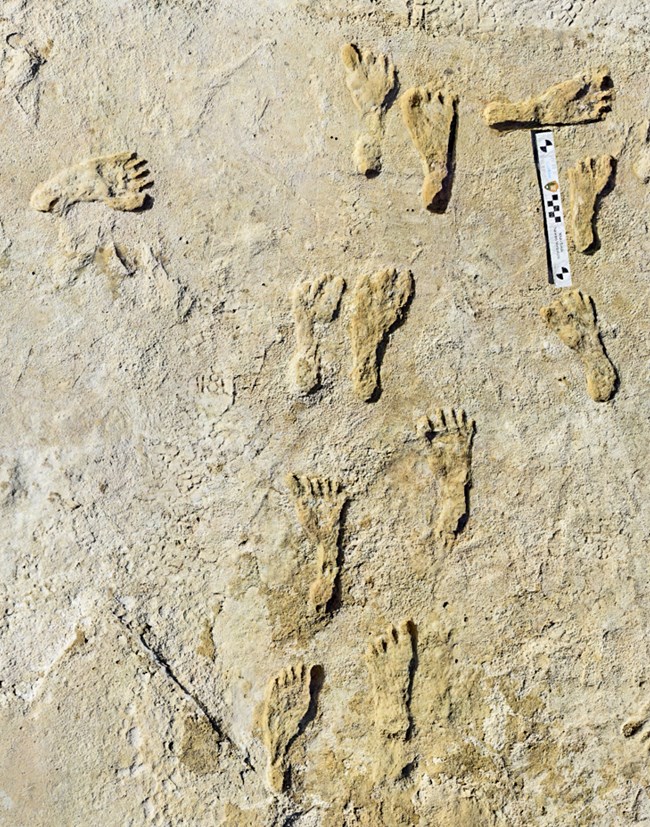
Archaeological sites, tools, footprints, DNA, and environmental evidence help researchers study early migration. Discoveries at places such as White Sands, New Mexico, have added to debates about when people first lived in the Americas.
No single discovery tells the entire story. Scientific explanations change as evidence improves. Indigenous nations also preserve their own origin histories and understandings of their relationship to the land. Studying the past responsibly means recognizing both evidence-based research and the living knowledge of Indigenous peoples.
Footprints Change the Timeline
At White Sands National Park, researchers found human footprints in layers of ancient lakebed sediment. Seeds located above and below some prints were radiocarbon dated. Multiple studies support an age of roughly 21,000 to 23,000 years, showing that people were present during the last Ice Age.
The prints do more than supply a date. Tracks made by children and teenagers, sometimes near the tracks of Ice Age animals, offer a rare glimpse of daily movement. They remind us that the first peoples were families and communities—not simply arrows on a migration map.
Check Your Understanding
Choose the best answer. If you miss one, use the feedback and try again.
How did the Ice Age help create Beringia?
Why is the peopling of the Americas described as a complex process?